
Article originally published in Fishing in Godzone Magazine, November 2025.
Trouble is brewing across the fishing community due to the new “protection areas” that limit public fishing in the Hauraki Gulf Marine Park. Some groups are celebrating the passing of the Marine Protection Bill enabling these new areas. We feel anger, sadness and disappointment. What was intended to be a well-rounded, restorative plan has fallen short of any meaningful change.
The Hauraki Gulf Marine Protection Act passed through as legislation in October 2025. Promises have been left empty and public trust broken.
The Act has established twelve High Protection Areas (HPAs) that prohibit all recreational fishing but allow for some commercial fishing in popular recreational fishing spots. There are also five new seafloor protection areas and extensions to two marine reserves.
Since 2004, the New Zealand Sport Fishing Council (NZSFC), LegaSea’s parent organisation, has invested thousands of hours and substantial resources into planning, consulting and collaborating on what was a deal to protect, restore and enhance the Hauraki Gulf.
What we see today is a disgrace. We’ve been left shortchanged, with hefty restrictions to public fishing for no real benefit to improve the health of the Hauraki Gulf Marine Park.
We invite you to feel and share our frustrations, and understand why the Hauraki Gulf Marine Protection Act is not good enough.
The Beginning of the End
Discussions with the community on a more vibrant Gulf started in 2013. Then, the NZSFC accepted an invitation to be a part of something meaningful, the Sea Change steering group. It was obvious that the abundance and biodiversity of the Gulf was in decline, so we joined mana whenua, commercial fishing interests, local and central government agencies, and recreational interests, to design a plan that would see the Gulf bustling with marine life once again.
The Sea Change planning process occurred over 2015 and 2016. Two years of intense debate, consultation, and cooperation. We and other stakeholders poured more than 6000 hours into this effort. The result was the Hauraki Gulf Marine Spatial Plan Sea Change released in 2017.
We were told to be bold, brave and ambitious. And we delivered. The Plan offered a real chance to ‘restore the mauri’ (life-force) of the Gulf for everyone.
The Sea Change Plan represented a groundbreaking consensus that promised a carefully curated package of marine protection including transitioning away from destructive bulk harvesting methods like trawling and dredging, and the establishment of innovative Special Management Areas to encourage high value, low extraction recreational fishing activity at selected sites – remarkable economy right where we need it, in the provinces.
It was agreed that the Plan would be adopted in its entirety. No cherry-picking.
After Sea-change
Out with the old and in with the new. In 2021, the Government released Revitalising the Gulf followed by the Hauraki Gulf Fisheries Plan in 2023 – replacing a plan with a plan to restore the Hauraki Gulf Marine Park.
It was underwhelming. The vision and integrity of the Sea Change plan was lost. Promises to not cherry-pick proposals were broken. A collaborative agreement turned into complete betrayal.
The NZSFC, LegaSea and other recreational groups rejected the 2021 and 2023 plans.
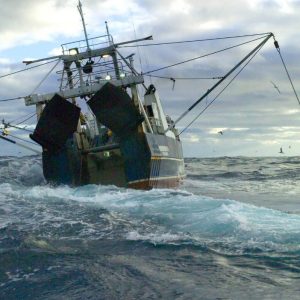
Proposals to transition away from bottom trawling were met with ‘trawl corridors’ – large zones where trawling could continue. Somewhat pointless considering the majority of existing trawling already occurs within the corridors. Essentially, no change.
The Special Management Areas designed to balance public utilisation while sustaining the fishery were scrapped. In their place, the Department of Conservation proposed HPAs with customary harvest that locked out both commercial and recreational fishers alike.
Even the bold idea to create a dedicated Fisheries Management Area for the Gulf was ignored. This would’ve allowed for tailored catch limits and controls to be applied specifically for the Marine Park, helping to address overfishing.
Meanwhile bulk harvesting of key baitfish species gets the green light. Between 2020 to 2023, over 5800 tonnes of blue mackerel and 1700 tonnes of jack mackerel were commercially taken from the Marine Park. These fish are vital food sources for other larger fish, dolphins, whales and seabirds. There is yet to be a stock assessment to understand the ecological impacts that this excessive bulk harvesting has on the ecosystem.
Fighting a losing battle
We continued to hold the line. In good faith, the NZSFC and recreational representatives wrote submissions, participated in stakeholder groups and provided evidence at Select Committee hearings. LegaSea did its best to raise public awareness.
The Hauraki Gulf deserves better. It deserves the bold vision promised by Sea Change – a future that discards destructive methods in favour of innovation, sustainability, and genuine prosperity for all New Zealanders.
Spatial plans and fishing bans do little to address the root causes of depletion. Where are proposals to address overfishing and land-based runoff?
Despite wide-spread public opposition, all parties in the House accepted the proposals which later became the Hauraki Gulf Marine Protection Act.
A last minute amendment by the Minister of Conservation added insult to injury, allowing a handful of commercial ringnet (gill-net) fishers to target kahawai, grey mullet and trevally in the HPAs surrounding Kawau Bay, Rangitoto and Motatapu Islands.
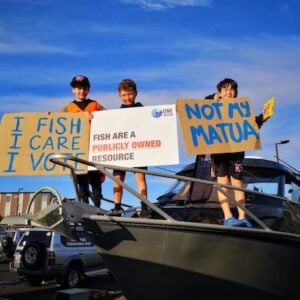
Meanwhile, everyday Kiwis are locked out. This amendment will be reviewed in three years. The HPAs and Seafloor Protection Areas won’t be reviewed until 2050.
Now what?
Politicians are now hiding behind the Act,claiming they have done their bit to restore the Marine Park. Reality is, they have again failed to address the root causes of depletion and degradation in the Gulf.
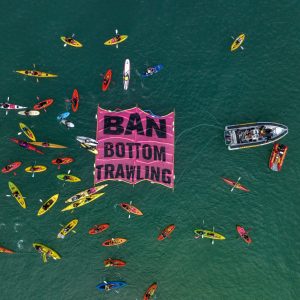
Fisheries Minister Shane Jones has already halted plans to restrict trawling in the Hauraki Gulf, despite 84% of Gulf residents supporting the removal of bottom trawling from the Marine Park.
The HPAs may have increased the marine protected area in the Marine Park from 6% to 18%. But it’s not good enough. The Hauraki Gulf seafloor needs 100% protection from destructive fishing methods.
As advocates for restored abundance, we’ve taken some hard knocks, but we’re still standing. We remain proud of the advocacy, energy and persistence we’ve shown over the past decade. The future of our fisheries depends on people who care enough to keep fighting.
By December 2025, we expect Shane Jones to propose a nationwide Amendment Bill that could change the way we fish forever. These ‘reforms’ risk silencing the public, increasing industrial catch and exports and weakening environmental safeguards.
Subscribe to LegaSea to keep informed about how you can make a real difference. If we don’t make enough noise to be heard in Wellington, we’ll get more ‘protections’ and even fewer meaningful changes to restore abundance.