
Thanks to Minister Shane Jones and YOU, our oceans are firmly on the political agenda this year.
Last election only one party had a dedicated fisheries policy. That has changed in 2026.
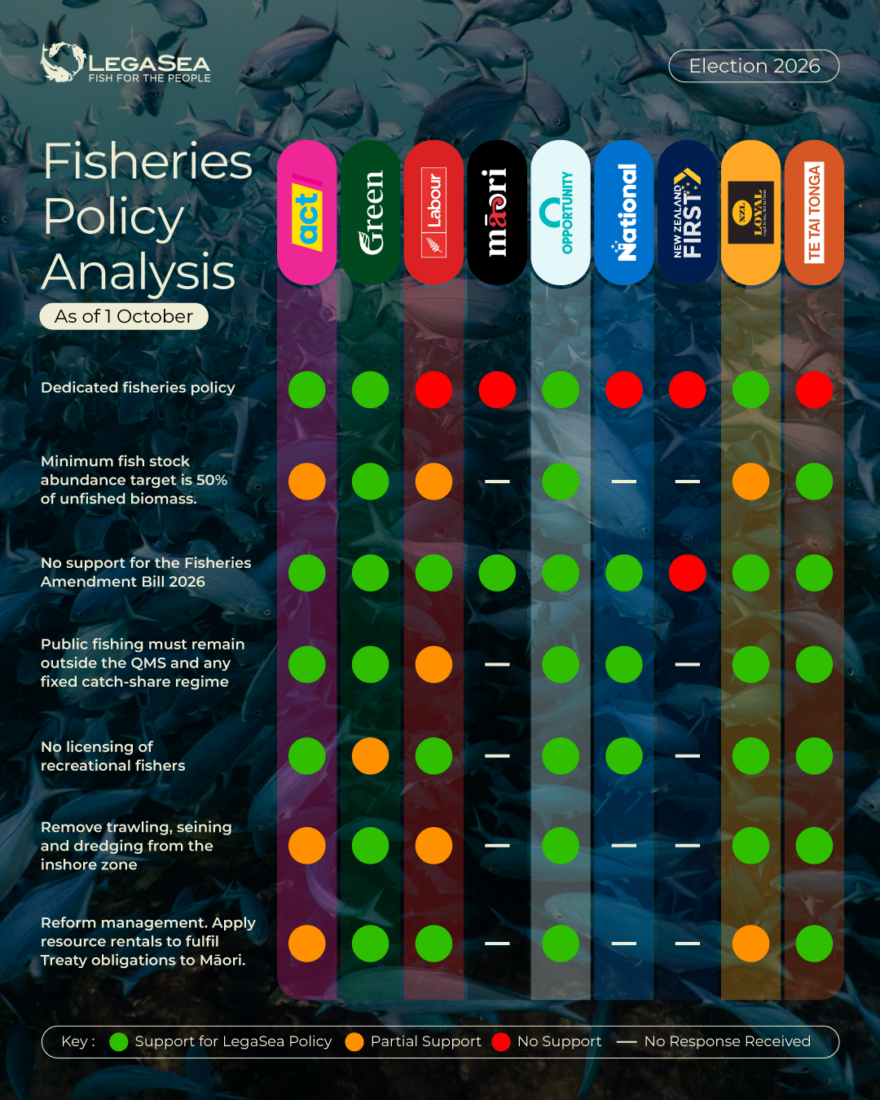
In August, LegaSea sent all the major parties a list of policy statements asking them where they stand in terms of restoring abundance in our marine waters. Their answers are mixed.
We’ve collated their responses into a simple policy table so you can see what your party is supporting in terms of banning trawling inshore and reforming the quota management system. If you want to dive deeper, there’s more detail online here.
Not all parties have responded yet, and not all parties will have a fisheries policy. But with huge public interest and mass support for Kill the Bill, we’ll keep updating the table as answers arrive.
LegaSea is non-partisan. We won’t tell you who to vote for, everyone’s priorities are different.
We’re here to give you the latest info so you can make an informed decision and back the party that best fits your needs and your vision for marine abundance. 🌊🐟
Below are full responses we received from major political parties in response to LegaSea’s Policy Statements.
Act
1. New Zealand fish stocks will be managed to a minimum biomass target of 50% of unfished biomass (B50) or the equivalent abundance that restores ecosystem function.
ACT supports progressively managing important fish stocks at higher levels than the current maximum-sustainable-yield approach. Higher abundance provides better recreational fishing, more efficient commercial fishing, and greater resilience when environmental conditions or scientific estimates change. We favour management settings that reflect the circumstances of individual fisheries while aiming for substantially greater abundance.
2. No support for the Fisheries Amendment Bill 2026.
ACT does not support the Bill in its current form.
3. Public fishing must remain outside the Quota Management System and any fixed catch-share regime.
ACT strongly supports recreational fishing and wants New Zealanders to have better opportunities to catch fish for themselves and their families. Our policy does not propose bringing recreational fishing into the QMS. Our focus is on increasing overall abundance so recreational and commercial fishers both benefit.
4. No licensing of recreational fishers
ACT does not support licensing of recreational fishers.
5. Reform fisheries management to restore marine abundance and use Resource Rental returns from fishing to recognise Treaty and Settlement obligations to Māori.
ACT strongly supports reforming fisheries management to restore abundance.
6. Remove trawling, seining and dredging from the inshore zone.
We favour targeting genuine environmental harm. ACT would permanently end scallop dredging in scallop fisheries that are currently closed, require the costs imposed by high-impact fishing methods to be reflected through fisheries levies, and strengthen incentives to adopt lower-impact fishing technologies.
The Green Party
1. New Zealand fish stocks will be managed to a minimum biomass target of 50% of unfished biomass (B50) or the equivalent abundance that restores ecosystem function.
The Green Party supports managing fish stocks to a minimum biomass target of 50% of unfished biomass (B50) or the equivalent abundance that restores ecosystem function.
2. No support for the Fisheries Amendment Bill 2026.
The Green Party has opposed and will continue to oppose the Government’s Fisheries Amendment Bill.
3. Public fishing must remain outside the Quota Management System and any fixed catch-share regime.
The Green Party supports reviewing the Quota Management System while ensuring public fishing remains outside any fixed catch-share regime. We do not support recreational fishing rights being turned into tradeable, private property assets and we want to see the general public maintain a shared, non-commercial right to fish without needing to buy quota.
4. No licensing of recreational fishers
The Green Party supports ensure that recreational fishing regulations address cumulative and long-term ecological effects and avoid harm to protected species, this could include investigating recreational fishing licensing.
5. Reform fisheries management to restore marine abundance and use Resource Rental returns from fishing to recognise Treaty and Settlement obligations to Māori.
The Green Party supports reforming our fisheries management to restore marine abundance and use Resource Rental returns from fishing to recognise Treaty and Settlement obligations to Māori.
6. Remove trawling, seining and dredging from the inshore zone.
The Green Party supports phasing out all destructive fishing methods including removing trawling, seining and dredging from the inshore zone.
Labour
1. New Zealand fish stocks will be managed to a minimum biomass target of 50% of unfished biomass (B50) or the equivalent abundance that restores ecosystem function.
Response: Labour supports science-based fisheries management that ensures abundant and healthy fish stocks for future generations. We recognise the importance of maintaining fish populations at levels that support both sustainable harvesting and healthy marine ecosystems. Any changes to biomass targets should be informed by robust scientific evidence and designed to restore ecosystem health while providing certainty for recreational, customary, and commercial users.
2. No support for the Fisheries Amendment Bill 2026.
Response: Labour does not support the current Fisheries Amendment Bill. We have consistently raised concerns about provisions that reduce transparency, weaken environmental safeguards, and undermine public confidence in fisheries management. Labour will discharge the Bill if elected.
3. Public fishing must remain outside the Quota Management System and any fixed catch-share regime.
Response: Labour supports ongoing public access to recreational fishing and recognises its social, cultural, and economic importance to New Zealanders. We support ensuring recreational and customary fishing interests are appropriately recognised within fisheries management decisions and believe any allocation decisions should be transparent, evidence-based, and reflect the public interest.
4. No licensing of recreational fishers.
Response: Labour has no plans to introduce a recreational fishing licence. Any future proposals affecting recreational fishers would require extensive consultation and a clear demonstration that they improve fisheries management outcomes. Recreational fishing is an important part of New Zealand’s way of life, and policy should support continued public access while ensuring sustainability of fish stocks.
5. Reform fisheries management to restore marine abundance and use Resource Rental returns from fishing to recognise Treaty and Settlement obligations to Māori.
Response: Labour supports ongoing reform of fisheries management to improve sustainability, transparency, and public confidence in the system. We recognise Treaty obligations and the importance of Māori participation in fisheries management. Future policy settings should ensure fisheries resources are managed for long-term abundance and deliver benefits to all New Zealanders while honouring settlement commitments and partnership obligations under Te Tiriti o Waitangi.
6. Remove trawling, seining and dredging from the inshore zone.
Response: Labour supports stronger protections for sensitive marine habitats and reducing the environmental impacts of fishing practices where evidence shows significant harm. We believe fisheries management should be guided by science and should target protection of vulnerable ecosystems while supporting sustainable fishing communities. We are open to further restrictions on destructive fishing methods in areas where they threaten marine habitats and biodiversity.
Opportunity
1. New Zealand fish stocks will be managed to a minimum biomass target of 50% of unfished biomass (B50) or the equivalent abundance that restores ecosystem function.
Opportunity supports a minimum biomass target of 50% of unfished biomass (B50), or the equivalent abundance that restores ecosystem function. We would also strengthen the current sustainability limts, while moving from single-species fisheries management towards an ecosystem-based approach.
2. No support for the Fisheries Amendment Bill 2026.
Opportunity opposes the Fisheries Amendment Bill 2026. We believe the process should start from scratch – it needs to be a robust, transparent and inclusive policy process that is focused on delivering better sustainability and ecosystem outcomes.
3. Public fishing must remain outside the Quota Management System and any fixed catch-share regime.
Opportunity supports keeping recreational and customary fishing outside any fixed catch-share regime. We support reforming the Quota Management System to require ecosystem-based management that delivers abundant fish stocks for all sectors.
4. No licensing of recreational fishers.
Opportunity does not see a strong case for licensing recreational fishers. We support the current multi-agency recreational fishing research process and will consider strengthening the process.
5. Reform fisheries management to restore marine abundance and use Resource Rental returns from fishing to recognise Treaty and Settlement obligations to Māori.
Opportunity supports reforming fisheries management to restore ecological abundance, while fully respecting Māori fishing rights and the integrity of the Māori Fisheries Settlement.
6. Remove trawling, seining and dredging from the inshore zone.
Opportunity supports removing trawling, Danish seining and dredging from the inshore zone and phasing out destructive bottom-impacting fishing methods more broadly, alongside stronger protection of critical marine habitats and a transition to sustainable, ecosystem-based fisheries management practices.
New Zealand Loyal
1. Fish stocks managed to a minimum biomass target of 50% of unfished biomass (B50) – SUPPORT IN PART.
NZ Loyal supports restoring fish stocks and marine abundance to healthy, sustainable levels. While NZ Loyal supports the objective, our published policy does not specifically prescribe a B50 target.
2. No support for the Fisheries Amendment Bill 2026 – SUPPORT.
NZ Loyal does not support the Bill and advocates fundamental reform of New Zealand’s fisheries management system, including abolition of the QMS.
3. Public fishing remains outside the Quota Management System and fixed catch-share regimes – SUPPORT.
NZ Loyal supports protecting recreational fishing as a public right and removing recreational fishing from quota-based management. NZ Loyal supports fair access to New Zealand’s fisheries for all New Zealanders.
4. No licensing of recreational fishers – SUPPORT.
NZ Loyal does not support licensing recreational fishers or introducing individual recreational quotas or compulsory quota-based catch reporting that would bring public fishing into the QMS.
5. Reform fisheries management to restore marine abundance and use Resource Rental returns to recognise Treaty and Settlement obligations to Māori – SUPPORT IN PART.
NZ Loyal supports fundamental fisheries reform, restoring marine abundance and meeting Treaty and Settlement obligations. However, the specific Resource Rental mechanism proposed by LegaSea is not expressly contained in NZ Loyal’s published policy.
6. Remove trawling, seining and dredging from the inshore zone – SUPPORT.
NZ Loyal specifically supports prohibiting bottom trawling within the 12-nautical-mile inshore zone, with industrial and bottom-contact fishing methods restricted to beyond 12 nautical miles.
Overall, NZ Loyal supports the fundamental objective of restoring New Zealand’s marine abundance, protecting recreational fishing access and reforming the current fisheries-management system.
Tākuta Ferris – Independent MP, Te Tai Tonga
1. Support B50. The ongoing depletion of fish stocks is still prevalent today. The QMS has continually failed to manage this issue. Many of the estimates of the fish stocks are known to be over estimated which leads to depletion of the actual stock.
- Moving toward B50 would place greater emphasis on restoring fish abundance and ecosystem health, rather than managing stocks primarily around sustainable levels. Higher abundance may provide greater resilience, while expert advice has also recommended that Aotearoa transition toward an ecosystem approach to fisheries management, including greater ecosystem monitoring and consideration of habitat and taonga species.
2. No support for FAB 2026. Reforms should not weaken environmental sustainability, precautionary decision-making, transparency or public accountability.
- Particular concern should be given to decisions made where information about fish stocks is uncertain and to restrictions on judicial review. Any alternative reform should strengthen ecosystem-based fisheries management and ensure that Māori customary and commercial fisheries interests, kaitiakitanga and existing Treaty settlement rights are appropriately recognised.
3. Public fishing must remain outside the QMS and any fixed catch-share regime. The right to fish and gather kaimoana is a birth right of all New Zealanders and should not be compromised by commercial interests. However, the customary right of Māori should always be the first consideration followed by recreational users.
- Support keeping ordinary public/recreational fishing outside an individual quota or fixed catch-share regime and providing stronger statutory protection for non-commercial fishing. However, any new allocation principle should recognise Māori customary fishing separately from general recreational fishing, reflecting its distinct Te Tiriti and Fisheries Settlement basis. Any reform should also be developed with iwi and ensure that prioritising non-commercial fishing does not unintentionally diminish Māori commercial quota, settlement assets or other rights secured through the 1992 Fisheries Settlement.
4. No licensing of recreational fishers. It is a birth right of all new zelanders to fish. If pressure of commercial fishers means that fish stocks of so depleted, that licensing of recreational users is neccesary, then it should be the commercial interest that must pull their weight to restore fish stocks, not public.
- Existing management tools, including bag limits, size limits and area or method restrictions, provide mechanisms for controlling recreational catch and can be adjusted for sustainability. Any changes to non-commercial fishing allocation should separately recognise and protect Māori customary fishing rights and interests.
5. Reform fisheries management. Upholding treaty and settlement obligations are paramount, and actively acknowledging the customary rights of tangata whenua.
- Support restoring marine abundance and recognising Treaty and Settlement obligations, but any active-fisher model must protect existing Māori ownership and control of settlement quota. Reform should be developed with iwi and ensure that rights and assets secured through the Fisheries Settlement are not diminished.
6. Remove trawling, seining and dredging from inshore. a thriving inshore fishery is paramount to the wellbeing of the entire marine environment and ecosystem and ensures stocks are abundant for all people of Aotearoa.
- Bottom-contact fishing methods, particularly bottom trawling and dredging, can damage seabed species, reduce habitat complexity and alter marine communities. Greater protection of sensitive inshore habitats would support marine ecosystem health and abundance. Any restriction should therefore be developed with iwi and implemented in a way that recognises customary fishing interests, Māori commercial fishing rights and Fisheries Settlement obligations.
—
We have not had a direct response from NZ First and Te Pati Māori. We will update this page when we do.