Article originally published in The Adventurer magazine, December 2025
For most of us, an early Saturday morning means heading out on the water to bring home kaimoana to share with friends and family. But on 22 November, more than 1000 Kiwis swapped the boat ramp for the Auckland harbour bridge, joining the One Ocean Protest with their boats, trailers and jet skis in tow.
The recreational fishing community turned out in force to oppose the creeping privatisation of our fisheries. Fishing rods were replaced with bold signs such as “Fish for the people”, “Hands off our Marlin”, and “I Fish. I Care. I Vote”.
If there’s one upside to the depleted state of our fisheries, it’s that more people are waking up to the reality that the Quota Management System is failing. Without the government confronting this truth, recreational fishers will continue to pay the price of mismanagement including more closures, meaning more restrictions on Kiwis seeking to fish and gather food.
While LegaSea did not organise the Protest, we proudly support the core message that our fisheries must be managed for the benefit of all Kiwis, not just a select few quota owners.
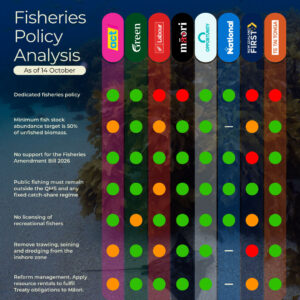
Recent proposals and legislative changes have exposed this government’s agenda to commercially harvest and export more fish, regardless of the social, cultural or environmental costs. There are good reasons why Kiwis are increasingly willing to speak out and push back.
Commercial fishing in protected areas
The Hauraki Gulf Marine Protection Act has established twelve High Protection Areas (HPAs) in the Hauraki Gulf Marine Park that prohibit all recreational fishing. But at the eleventh hour, an amendment was inserted behind closed doors without public consultation allowing five commercial gill-netters to harvest finfish including trevally, grey mullet and kahawai inside two of the new HPAs.
This was a wake-up call for many fishos. What’s the point of a ‘protected area’ if it’s only protected from the public?
Instead of meaningful protections, we’re left with a double standard that closes off safe fishing areas popular with recreational fishers and their families, while delivering little benefit to improve the health of the Gulf.
Scallops are gone, crayfish could be soon to follow, and when was the last time you saw a tarakihi? Yet the Act fails to provide any bold measures to address the key drivers of depletion.
Despite numerous submissions and calls from LegaSea and the New Zealand Sport Fishing Council, measures in the Act to address the excessive bulk harvesting of key species and destructive fishing methods fell short. It’s clear whose interests carried the most weight.
Hands off our marlin and reef fish
As fish abundance declines, the pressure from industry to “remove redundant regulations” grows louder.
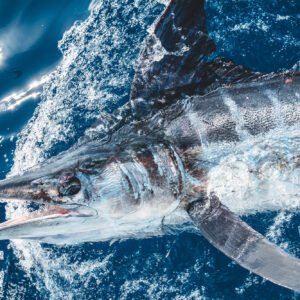
In October, at the request of commercial fishers, the government proposed a pathway to commercialise marlin, one of the last remaining non-commercial fisheries. The proposal would allow commercial fishers to keep and sell dead marlin, as well as 19 vulnerable reef fish species including red moki and boarfish.
Introducing an economic incentive is risky. It’s likely to incentivise some commercial fishers to shift behaviours to target and increase catches of these species.
Currently, marlin are caught as bycatch in the commercial tuna longline fishery. Because the marlin have to be released, this is a deterrent from fishing in northern waters during summer unless there are tuna to catch.
The industry argues that allowing the sale of dead marlin reduces wastage. This narrative is a smokescreen to create a new revenue stream from a public fishery.
We’ve seen the consequences of removing similar regulations protecting broadbill. In the 1990s the government allowed the commercial sale of dead broadbill swordfish caught as bycatch. Shortly after, commercial catches skyrocketed, broadbill became a profitable target species and was eventually included in the Quota Management System in 2004.
Our marlin are not for sale. The New Zealand Sport Fishing Council and LegaSea raised these concerns in our submission to Fisheries NZ in November, alongside more than 20,000 concerned Kiwis.
Where to from here?
This year has exposed the capture of government officials who are willing to do the commercial industry’s bidding despite the downside risks to the environment and the impacts on everyday Kiwis.
If we want restored abundance and future generations to enjoy the same fishing experiences we treasure, we must keep pushing back.
LegaSea’s mission is to raise public awareness of issues impacting our coastal fisheries. Our parent organisation the New Zealand Sport Fishing Council continues to represent recreational fishing interests in government processes and submissions. But we can’t do this alone.
Advocating for meaningful change requires the weight of public support behind us. Consistent public pressure and opposition makes it harder for the government to dismiss our concerns.
If you want to help make a difference, sign up and join the LegaSea community so you can keep informed and make sure your voice is heard when the time comes. Together we can turn the tide.