Allocation FAQs
All FAQs |
Customary Fisheries | Fisheries Management | maximum sustainable yield | QMS | Economics | Fishing | Rescue Fish | Environment | Fishing methods | Recreational Fishing | Fishcare | customary | Kahawai | Reform scam | Baitfish | Scallops | Crayfish | WRC decision | Marlin | Reef fish | Deemed value penalties | Judicial Review | Kill the Bill | Tarakihi | Release mortality | Election | Politics | Bottom trawling
 October 28, 2017
Two important surveys are under way to measure harvest by marine recreational fishers. LegaSea encourages you to cooperate with the researchers if they phone you or approach you on the boat ramp. Over the next 12 months NIWA will be measuring and counting fish landed by recreational anglers at popular boat ramps. This large-scale survey ... Read more.
 October 4, 2017
It’s been difficult finding anyone who believes the propaganda appearing on our screens that extols the virtues of the Quota Management System. Fishing corporates have spent millions in an effort to convince us that they are looking after our marine resources for our kids and grandkids and all is well. Nothing could be further from ... Read more.
 August 8, 2017
A new approach to managing New Zealand’s fisheries is needed The New Zealand Sport Fishing Council has released its Manifesto and calls on New Zealand’s political parties to consider a new approach to setting policy. The Council has consulted with its members over what they want to see in terms of stewardship of New Zealand’s ... Read more.
 August 1, 2017
The New Zealand Initiative, a consultancy that is paid to produce reports of a right wing nature, has produced a report that says recreational fishers need to be licensed because of a massive problem in the fishing sector. There is a massive problem in the fishing sector – recreational fishers are not it. The report’s ... Read more.
 April 12, 2017
What’s going on in our fisheries? In the past week there has been claims and counter-claims about the cosy relationships between fisheries officials and corporate commercial interests. For years these dealings have been shaded from public view. Thanks to your support LegaSea and others have put the spotlight on these arrangements and we are now ... Read more.
 April 5, 2017
At LegaSea we are regularly asked, “What is the story with everyone reporting their recreational catch?” and “do you support individual reporting?” Short answer, no. We prefer an independent assessment of all catch to avoid any bias that may arise from self-reporting. We currently have internationally acclaimed, robust and reliable recreational estimation method designed by ... Read more.
 April 3, 2017
Recreational catch reporting is often touted as the missing link in the fisheries management equation. Truth is New Zealand has a world-leading method of estimating recreational catch. It is highly independent to avoid the bias associated with self-reported catch that often plagues estimates of commercial catch, and licensing requirements. More information does not always equal ... Read more.
 March 31, 2017
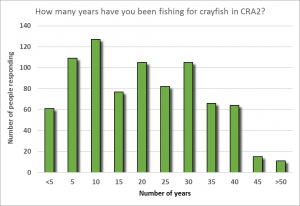
New Zealand Sport Fishing Council March 2017 Between January and March 2017 a survey was conducted to measure people’s perceptions of the state of the rock lobster (crayfish) fishery on the northeast coast of the North Island, known in management terms as CRA 2. Over 800 responses were received, with many respondents having dived or ... Read more.
March 20, 2017
A landmark survey of people who pot and dive for crayfish on the northeast coast between Pakiri and East Cape defies Ministry for Primary Industries’ assurances that the fishery is doing well. More than three quarters (78.6%) of the 822 survey respondents described the size and availability of crayfish in this popular fishery as 1 ... Read more.
 February 9, 2017
As we fish through another summer of mixed success we’ve had lots of time to think about our fisheries and wonder how we’ve got it so wrong. Our fishing is not the same as what our forefathers had and it’s pretty scary to think what we have to pass onto our next generations. Thankfully the ... Read more.