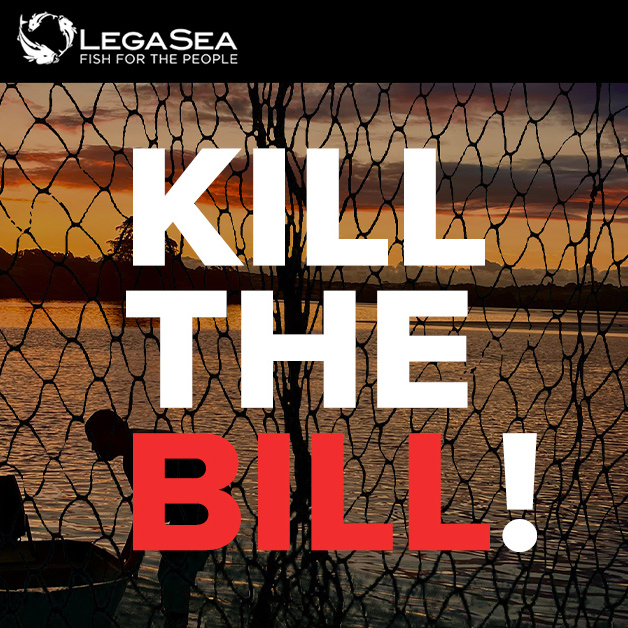

Kill the Fisheries Amendment Bill!

The Fisheries Amendment Bill is currently before Parliament. The new Bill includes a multitude of proposals that threaten the future of our fisheries, including removing removing environmental safeguards when setting commercial catch limits and transferring more power to the Minister when making catch decisions.

The Bill has gone to the Primary Production Select Committee where it is now open for public consultation.

You can make a submission using our handy form here, or do it here on the parliamentary website.

The deadline for submissions to the Select Committee is 29 April 2026.

The process

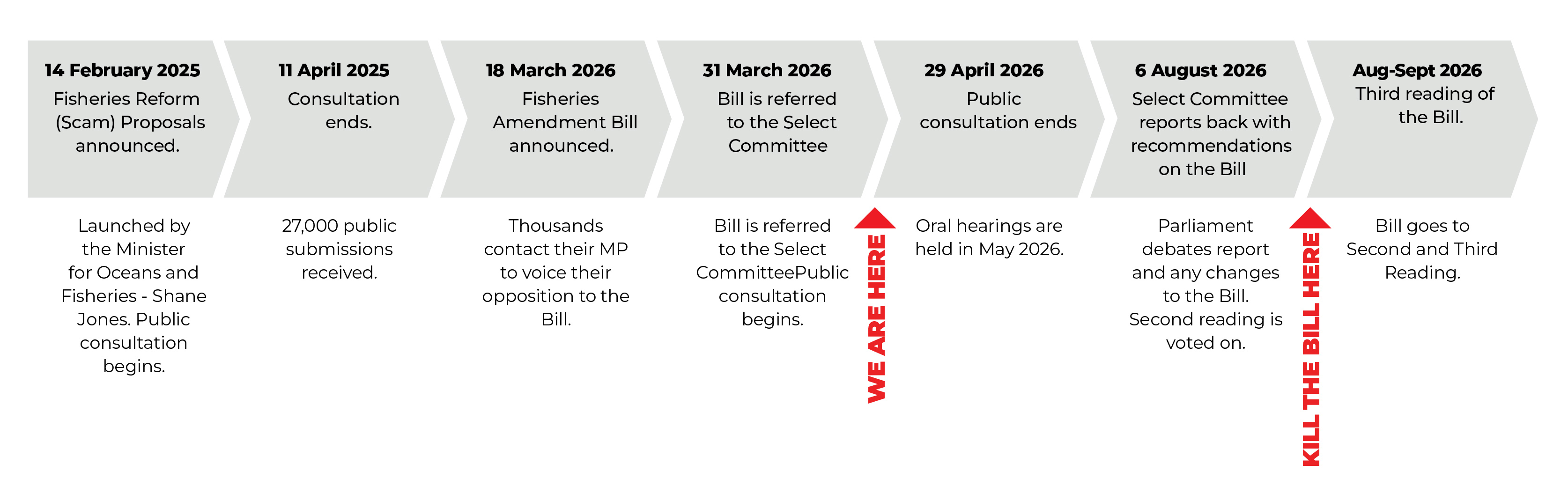
The Bill has passed its first reading in Parliament and has been sent to the Primary Production Select Committee. Public consultation is now open.

The main proposals were released in February 2025 where over 27,000 people made submissions, predominantly rejecting them in their entirety. This opposition has been ignored and form the basis of the Fisheries Amendment Bill 2026.

Once consultation has finished and the Select Committee has made its report by 6 August 2026, the Bill will be voted on after the 2nd Reading. This is where we need to Kill the Bill.
What’s in the Bill

The Fisheries Amendment Bill is a comprehensive range of changes to the Fisheries Act that favour large quota owning fishing companies. Our main concerns are:

  1. The Bill prioritises exports and private interests. Feeding Kiwis must come first.
  2. Lack of transparency. No public access to camera footage. Decision making goes behind closed doors while public input is limited.
  3. The Bill destroys environmental safeguards so the Minister can legalise dumping and the catch of undersized fish, while increasing commercial catch limits. We can expect more trawling along our coastline.

Below is a list of the relevant points of the Bill and our concerns.

Clause Proposal Core issues
Onboard camera footage

New section 227 and section 252


  1. Section 227H – Official Information Act 1982 does not apply to camera recordings.
  2. Section 252(5AA) – Persons knowingly disclosing camera footage or knowingly contravening conditions on use, storage or destruction of footage fined $50,000.
  1. The public will no longer have access to footage from onboard cameras.
  2. The public paid for the cameras and is now being denied access to footage.
  3. There will no longer be independent verification of compliance.
  4. Onboard camera footage has historically highlighted the flaws within the commercial self-reporting regime.
  5. The hefty fine reflects officials’ desire to maintain secrecy.
20 working day limit for judicial review

New section 313A

Relevant articles:

  1. Fast-tracking marine depletion while silencing our voices. LegaSea. March 4 2026.
  2. The gloves are off. LegaSea. September 16 2025.
  1. An application for review under the Judicial Review Procedure Act 2017 that relates to statutory powers made under the Fisheries Act must be filed with the High Court no later than 20 working days after the decision is notified.
  1. Unreasonably short timeframe for the public.
    The 20 working day deadline applies to all Ministerial decisions despite how complex they may be.
  2. Systematically disadvantages under-resourced groups and members of the public.
  3. Significantly less time than international jurisdictions which are generally 3-months.
  4. Undermines obligations to the Treaty of Waitangi. Tikanga processes are incompatible with an arbitrary deadline.
  5. Goes against the advice by Officials who recommended a 3 month or 6 month time limit depending on the decision.
Minimum legal sizes

Amend Regulation 31 Fisheries (Commercial Fishing) Regulations

  1. Remove the commercial minimum legal size for blue cod.
  2. Remove the commercial minimum legal size for blue moki, butterfish, flatfish, sand flounder, kingfish, red cod, snapper, tarakihi, trevally.
  1. Permits fishers to land and sell juvenile fish before they have had a chance to reproduce.
  2. Removes incentives for commercial fishers to transition away from bulk harvest, non-selective fishing methods.
  3. Being sold as an amendment to “resolve wastage”. Increases wastage. Doesn’t fix the core issue of bulk harvest, non-selective fishing methods.
Sustainability measures other than total allowable catch

Amended section 11

Relevant articles:

  1. Minister’s proposal weakens fisheries law
  1. Redefines the current “section 11 Sustainability Measures” to now exclude catch limits as a sustainability measure.
  2. Permits the Minister to set a high Total Allowable Catch whilst ignoring broader environmental context.
  1. The Minister’s decisions on catch limits will now be managed independently from where and how fish are harvested.
  2. The Minister will set the Total Allowable Catch under an amended section 13 which requires minimal environmental consideration.
  3. Catch settings can be made in isolation from broader marine management. The Minister can ignore marine spatial plans set under the Resource Management Act and Conservation Act.
Standard factors when setting catch limits

Amended section 13

  1. Introduces six “standard factors” the Minister must consider when setting catch limits.
  2. Replaces the current requirement to consider “effect of fishing on any stock and the aquatic environment”.
  1. Makes it easier for the Minister to set higher catch limits.
  2. Reduces environmental considerations when setting catch limits.
  3. When setting a catch limit the Minister only considers the 98 species within the Quota Management System.
  4. The Minister only considers the effect of catch limits on predator and prey interaction at the Quota Management Area level, this disregards localised management and will affect rocky reef ecosystems.
  5. Removes the Minister’s requirement to consider the needs of future generations.
Low information stocks

New section 13D

  1. Introduces new rules for when setting catch limits for low, medium, and high information stocks.
  1. Requires less information when setting catch limits.
  2. Makes it easier to set and maintain high catch limits even when information is uncertain or unavailable.
  3. Inherently risky for low information stocks.
  4. Ignores international best practice which requires greater environmental protection for low information stocks.
  5. Most fish stocks in New Zealand would be classified as low information due to lack of reliable data.
In-season catch limit increase

New section 13E

  1. Allows the Minister to increase catch settings in the middle of the fishing season.
  2. In-season increase for highly variable stocks as listed in Schedule 2 of the Fisheries Act or stocks classified as high and medium knowledge stocks.
  3. Fish stocks classified as “highly variable” include flatfishes, red cod, and scallops.
  1. Creates more opportunity for the commercial fishing sector to lobby for a Total Allowable Commercial Catch increase.
  2. More work for everyone, more public consultation, more submission writing.
  3. Additional ACE created, with no benefit for recreational or customary.
  4. In-season increase based on incomplete, potentially misleading data, with minimal environmental consideration.
Consideration of  environmental matters in setting a Total Allowable Catch

New section 13F

  1. The Minister must take into account the adverse effects of fishing for the stock on the aquatic environment and the environmental principles only to the extent that they are relevant to the standard factors.
  1. Makes it easier for the Minister to set higher catch limits.
  2. Environmental effects and environmental principles can be considered but only “to the extent relevant to standard factors”.
  3. If an effect doesn’t fit within these factors, it can be ignored.
  4. Reverses current legal requirements to assess the effect of fishing on the marine environment.
  5. Dismantles decades of environmental safeguards built under the current Fisheries Act.
Multi-year catch decisions

New section 14F

  1. The Minister can set a Total Allowable Catch for the upcoming fishing year and subsequent years for a specified period, up to 5-years.
  2. The Minister may set a different catch limit for each fishing year within the specified period.
  3. Can set increasing or decreasing Total Allowable Catch trajectory dependent on the state of the fishery.
  1. Allows the Minister to ignore signals of depletion.
  2. Total Allowable Catch can be locked in for up to 5-years. No annual review required during that period.
  3. Provides long-term certainty for industry, long-term risk for the environment.
  4. Only one opportunity for public consultation before the multi-year catch settings are implemented. No opportunity for public input over the specified period.
Recognise commercial non-regulatory measures

New sections 14I, 14J, 14K

  1. Application to have non-regulatory measures considered when setting catch limits.
  2. One or more quota owners can apply for voluntary measures to influence the Total Allowable Catch.
  3. Non-regulatory measures include voluntary reduction in harvest, not fishing in certain areas or at specified times of the year.
  1. Self-regulation rewarded with increased catch limits.
  2. Requires sufficient information, however, there is no minimum standard for sufficient details.
  3. No enforcement measure. These measures are voluntary; the Minister can observe non-compliance but can’t punish it.
Management procedures

New sections 14L-14T

  1. Management procedures are pre-set decision rules that operate for up to 5 fishing years. They automatically adjust catch limits based on data inputs.
  2. The Minister sets a management procedure, in subsequent fishing years the Chief Executive implements the management procedure automatically.
  1. Reduces public input, the public only has one opportunity to have their say.
  2. No annual Ministerial review during the operation of the procedure, powers are passed on to an appointed official.
  3. If the Chief Executive thinks a decline in the fishery is due to natural fluctuations they are not required to reduce catch limits. Completely disregarding growing uncertainty in environmental conditions.
  4. Makes it easier to increase and maintain high catch limits and harder to reduce them.
Management procedures – proportional allocation

New section 14L

  1. The management procedure must include operating rules that prescribe the levels to which the Chief Executive must vary the total allowable catch and total allowable commercial catch for the stock.
  1. States that a management procedure can apply to recreational and customary allowances, therefore introducing proportional allocation.
  2. Public interests are no longer protected by the Minister and are treated on par with the allocation of commercial catch.
Carry-forward Annual Catch Entitlement (ACE)

New section 67C and section 67D

  1. New provisions allowing quota owners to apply for extra fishing rights when “exceptional circumstances” prevent them from catching their full allocation.
  1. Under the current Fisheries Act, up to 10% of uncaught  Annual Catch Entitlement can be carry-forward to the second year.
  2. Amendment will allow for a greater carry-forward. Industry self-determines how generous the relief for an “exceptional circumstance” should be.
  3. No requirement for public consultation, scientific review of sustainability implications, independent assessment of whether circumstances are exceptional.
  4. Could be used as a means to lock out small-scale operations.
Returns and discards of fish

Amendment to section 72(3A)

  1. A commercial fisher who takes any fish or other animal that is aquatic life subject to the quota management system may return it to, or abandon it in, the sea or waters from which it was taken if observed by an onboard observer or onboard cameras.
  1. Discards of fish must be recorded and reported against catch.
  2. Camera monitoring is not reliable enough to determine species or quantities of fish.
  3. Still heavily reliant on self-reporting which is flawed due to economic incentives to only land high-value fish and dump others overboard.
Increase in total allowable commercial catch to reflect discards

New subpart 4(23)

  1. The Minister may increase the total allowable commercial catch for a quota management stock for its next fishing year to reflect the removal of a permission or requirement to return or abandon the stock.
  1. Grants the Minister broad, unchecked power to increase the catch limits without further public consultation.
  2. Relies on self-reported, poorly identified data with no verification. Increases can be driven by manipulated commercial reporting.
  3. High risk to low-information and inshore fish stocks.
New deemed value fines

New section 75(5A)

Relevant artlices:

  1. A fine is meant to change behaviour. At sea, that principle is being abandoned.ink
  1. The Minister may set an annual deemed value fine for an inshore stock that is taken by a deepwater freezer vessel that is different from the fine for the same stock taken by another vessel.
  1. This amendment is inequitable and favours deepwater quota owners at the expense of inshore small-scale ACE fishers.
  2. Incentivises bulk harvest fishing methods.
  3. Increases pressure on inshore fish stocks.
  4. This change is particularly relevant for the west coast jack mackerel fishery and will affect gurnard, snapper and kingfish.


This Bill is reckless and short-sighted. It removes critical checks and balances that safeguard our marine environment. With your support, we can show the government that Kiwis won’t stand by and let this happen.

The changes are not a reform. They are a scam. They jeopardise the health of our marine environment. Our access to a healthy and abundant fishery is on the line. Don’t let it be cut.

We need thousands of people to speak up. It will take less than 5 minutes to make a submission using LegaSea’s online form. Tell the Minister you reject the privatisation of our fisheries.

Want to do more?

  1. Make a submission.
  2. Get your best mate to make a submission.
  3. Get your family to make a submission.

FAQs

How can I help Kill the Fisheries Amendment Bill?

Speak up.  Oppose the Bill by making a submission by 29 April 2026. Click here to build your submission using LegaSea’s online template.  Then go tell your friends and family to submit. Tell them this will be one of the most important things they do before the November election. The Amendment Bill has passed its […]

Supporting information:

Media Releases

  1. Fisheries reforms prioritise Industry over public interest – 14 February 2025

Articles

  1. Officials flag risks in Jones’ bid to cut penalties for deepwater fisheriesNewsroom, 23 Jan 2026
  2. Shane Jones plans bycatch rule shake-up to cut costs for deepwater fishersNorthern Advocate, 16 Jan 2026
  3. Fisheries Ministers’s constraint on court challenges ‘restrictive’ – officialsNewsroom, 27 Aug 2025
  4. Government agrees to pro-industry fisheries changesNZ Herald, 6 Aug 2025
  5. Fishing industry nets changes to cameras, discards and catch restrictionsNewsroom, 6 Aug 2025
  6. Reforms to allow greater catch limits, on-board camera footage to stay hiddenRadio NZ, 6 Aug 2025
  7. Privatisation proposals shrouded in weasel speak –  LegaSea, 11 March 2025
  8. Public loses out on fisheries deregulationLegaSea, 25 Feb 2025
  9. Shane Jones Fisheries Reforms Prioritise Industry over Public InterestLegaSea, 12 Feb 2025

Newsletters

  1. The reform scam returns – and it still stinks – 6 Aug 2025
  2. Shane Jones is an Island (and not a healthy one) – 20 March 2025
  3. Introducing the Fisheries Reform Scam – 12 March 2025
  4. Nothing to see here – Jones Threatens To Reduce Transparency – 5 March 2025
  5. Public fish, private profits – who does Shane Jones really serve? – 24 Feb 2025

More Information:

  1. A 2024 Ministry for Primary Industries report revealed a staggering 46% increase in fish being tossed overboard after cameras went live on a portion of the commercial vessels. The report shows that cameras are effective at incentivising improved reporting.
    • Discards of kingfish have increased by 950% compared to what was previously reported.
    • Discards of snapper have increased by over 1000% compared to what was previously reported.
    • Reported dolphin captures were up by 680% times and albatross interactions by 350%.
  2. A 2019 Horizon Research study found 58% of New Zealanders thought bottom trawling that destroys fish habitats and targets small fish in the inshore fishery should be banned.
  3. The same Horizon Research study found 70% of New Zealanders believed that fisheries needed to be reformed to ensure there is an abundant fishery. Not to deregulate the controls on commercial fishing.
  4. Two Ministry for Primary Industries research projects, from 2016 and 2021, cover the operation of cameras to monitor catches aboard commercial fishing vessels. Reviewing 100% of all catch sorting and stowing for all vessels is not humanly possible. There are limitations. Even with AI there is no way to determine from the camera footage the exact size of fish or weight of a bin of fish.Even with cameras, management will need to rely on trust and the self-reported data provided by commercial fishers. Until technology and placement improves, cameras are no substitute for onboard human observers. Current rates of observer coverage of inshore commercial fishing activity is poor.
  5. A 2016 study found the total economic contribution of marine recreational fishing by residents and visitors was $1.7 billion per annum, while taking less than 6% of the national catch. Recreational fishing contributes a conservative $188 million in tax revenues to help keep New Zealand functioning, while generating full-time employment for over 8,000 people.


Related articles

LegaSea newsletter #184 – If you thought killing baby snapper was bad…
March 30, 2026 The Fisheries Amendment Bill heads to its first reading TOMORROW 31 March. The purpose of the Bill is set out on page one, “to grow the value of seafood sector exports while continuing to ensure sustainability.” It’s clear the Bill prioritises seafood exports. That means everything else becomes an afterthought – the fish, the environment ... Read more.

MEDIA RELEASE: Fisheries Bill Still Not Dead
March 25, 2026 MEDIA RELEASE Wednesday, 25 March Fisheries Bill Still Not Dead Pressure is growing on the government to drop a controversial Bill that has riled the public into action over the past week. Fishing and environmental advocacy groups have been rallying against the Fisheries Amendment Bill since its release last week. The ‘Kill the Bill’ campaign ... Read more.

LegaSea newsletter #182 – The Reform Scam is back
March 19, 2026 Today Minister Jones has released the most sweeping changes to fisheries legislation since the quota system was introduced. We have limited time to analyse the Fisheries Amendment Bill before your local MP gets to vote in support or against it.  If you were one of the 27,000 Kiwis who submitted on last year’s proposals, it’s clear your ... Read more.

Kiwis Aren’t Buying the Government’s Fisheries Reform Package
March 18, 2026 Few things unite Kiwis like the ocean. Our love of being out on or under the water runs deep. The Auckland Boatshow in early March showcased this, where thousands turned out to support the marine businesses that make our time on the water possible. Thanks to NZ Marine, the LegaSea team were lucky enough to ... Read more.

Fast-tracking marine depletion while silencing our voices
March 4, 2026 LegaSea exists to highlight the public’s stake in a healthy, abundant ocean. That’s why we’re deeply concerned about proposed changes to the Fisheries Act that would make it harder for the public to challenge fisheries decisions that affect us all. Shane Jones, the Minister for Oceans and Fisheries, is proposing to cut the time allowed ... Read more.

LegaSea newsletter #181 – Fines, closures and coffee. What a mix
February 20, 2026 In case you missed it, there’s a Fisheries Amendment Bill (scam) working its way through the system right now, and while it might sound technical, we aim to break it down into tangible, understandable bites for you. Over the coming weeks, we’ll be unpacking key parts of it, starting with deemed value penalties. On paper, ... Read more.

LegaSea newsletter #180 – I fish. I care. I vote.

February 5, 2026 If you’ve been with us a while, you’ll know LegaSea doesn’t exist to make noise for the sake of it. We exist because New Zealand’s fisheries matter, because access to our kaimoana matters, and because abundance doesn’t come from wishful thinking or political lobbying. It comes from effective management that puts ecosystems first. It comes ... Read more.

Radical changes not in our interests

October 22, 2025 None of us had a say in it yet the Coalition agreement has become the excuse to drive radical change. Even in the face of overwhelming public opposition.  In terms of fisheries, the Coalition agreement reads –  “Deliver longer durations for marine farming permits and remove regulations that impede the productivity and enormous potential of ... Read more.