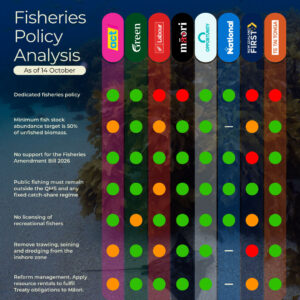

The Quota Management System (QMS) turns 40 this year. Join us as we break down some of the key failures of the QMS and why we think it’s time it was replaced with something more innovative.
The Quota Management System (QMS) was introduced in 1986 to address fish depletion and overcapacity in the commercial fishing sector. That is, too many people chasing too few fish.
The solution was to gift commercial fishers quota, a tradeable share of each fish stock based on historical catches. The theory was that by giving away a long-term perpetual lease, it would breed stewardship.
It didn’t.
As predicted at the outset, corporate interests seized the opportunity to take control. Now, access to harvest fish is determined by private interests, not the Crown. Thousands of small-scale regional fishers have been pushed out.
A handful of entities now control more than 80% of all quota, and many who still fish must lease catching rights from quota owners who never go to sea.
Their lease costs are so high it incentivises low cost, bulk harvesting over less impactful fishing methods. Consequently, economic returns are prioritised over ecological sustainability, despite the Fisheries Act and multiple court decisions making it clear that the fish must come first.
Forty years on, the so-called world-leading QMS has failed to do what it was primarily intended to do. It has failed the fish, the fishers, Māori and our coastal communities.
Over the coming weeks, LegaSea will break down some of the top failures of the QMS, and offer viable alternatives leading up to the 7 November election.
Because this year you have the power to vote for abundance and meaningful reform of the management of our coastal fisheries.
I Fish. I Care. I Vote.