Bottom trawling FAQs
All FAQs |
Customary Fisheries | Fisheries Management | maximum sustainable yield | QMS | Economics | Fishing | Rescue Fish | Environment | Fishing methods | Recreational Fishing | Fishcare | customary | Kahawai | Reform scam | Baitfish | Scallops | Crayfish | WRC decision | Marlin | Reef fish | Deemed value penalties | Judicial Review | Kill the Bill | Tarakihi | Release mortality | Election | Politics | Bottom trawling
 January 26, 2020
LegaSea is celebrating the courage of Karl and Sarah Warr from Hawke’s Bay who have installed cameras on their trawler to livestream their fishing activity 24/7. This Napier couple wants the public to see for themselves how their fish is caught. They are hopeful that consumers will start asking their suppliers if the food they ... Read more.
 December 9, 2019
Let’s get real, LegaSea is not anti-commercial fishing. We want small-scale, low impact commercial fishing to be successful. LegaSea is against the Quota Management System and an inadequate Fisheries Act that fails to protect our fish stocks for future generations. Far from being innovative, over the past 30 years the QMS has been a backward ... Read more.
 November 30, 2019
A recent government report on the state of our marine environment raises legitimate concerns about the lack of information on fishing levels, the impacts of fishing, and that fishing has become more industrialised. The report, Environment Aotearoa 2019 was a joint initiative by the Ministry for the Environment and Stats NZ. The report authors make ... Read more.
 November 22, 2019
From October 1st Stuart Nash has reduced the commercial catch of tarakihi on the east coast of the North and South Islands by 10 percent. LegaSea was calling for a 40 percent reduction. The arguments for minimal cuts were bolstered by an economic report commissioned by Fisheries New Zealand describing the impacts of any changes ... Read more.
 November 20, 2019
In the Bay of Plenty we don’t have to look far for evidence that the Quota Management System is not working. LegaSea is concerned that the failure of the QMS is having major consequences. Moreover, the inaction by Fisheries New Zealand and the Minister of Fisheries Stuart Nash to address the serious issues of depletion ... Read more.
 November 5, 2019
There are a lot of things people did in the 1900s that are not acceptable today. One of those unacceptable behaviours is bottom trawling in inshore waters. Science shows us that bottom trawling catches fish indiscriminately and it impacts on the seabed, killing the three dimensional structure that supports essential organisms. Those organisms attract small ... Read more.
 November 5, 2019
In 2017 MPI openly admitted that bottom trawling and dredging are the most destructive fishing methods, causing damage to seabed habitats and reducing the density and diversity of the species that live there. So why is trawling and dredging still permitted inshore? Mitigating the effects of fishing on the marine environment is a core function ... Read more.
 October 31, 2019
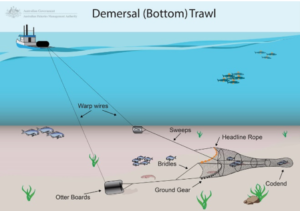
What is trawling? A trawl is a tunnel shaped fishing net which is towed through the water by a vessel on the surface of the water. As the net is towed through the water strains out through the mesh entrapping the fish and retaining them in the cod end of the trawl bag. The ... Read more.
 October 31, 2019
Bottom trawling is an indiscriminate fish harvesting process, capturing all in its path and scraping vital marine growth off the seabed. The damage is unseen as it’s underwater and out of sight. The environmental impacts from the agricultural sector is attracting increasing attention and public concern about the damage caused by some commercial fishing methods ... Read more.
 October 30, 2019
Bottom trawling is an industrial fishing method that involves dragging a large, weighted net along the seafloor with the intention of mass collection. In this short video, Dr Simon Thrush, a marine scientist from Auckland University, discusses how bottom trawling works and why it is so destructive. LegaSea believes bottom trawling needs to be stopped ... Read more.