
Kill the Fisheries Amendment Bill!
The government is pushing through offensive legislation that means fewer fish in the water and less protection for our marine environment.
The Fisheries Amendment Bill is being rushed through with limited public consultation. There’s good reasons why the Coalition government are rushing it. They want to:
- Ban public access to onboard boat camera footage.
- Fine anyone leaking that footage up to $50,000.
- Ignore the impacts of bottom trawling, seining and dredging.
- Restrict legal challenge to an unrealistic timeframe of just 20 working days.
- Allow more fish to be dumped overboard.
- Slash fines for commercial fishers who exceed their catch limits.
We can stop this
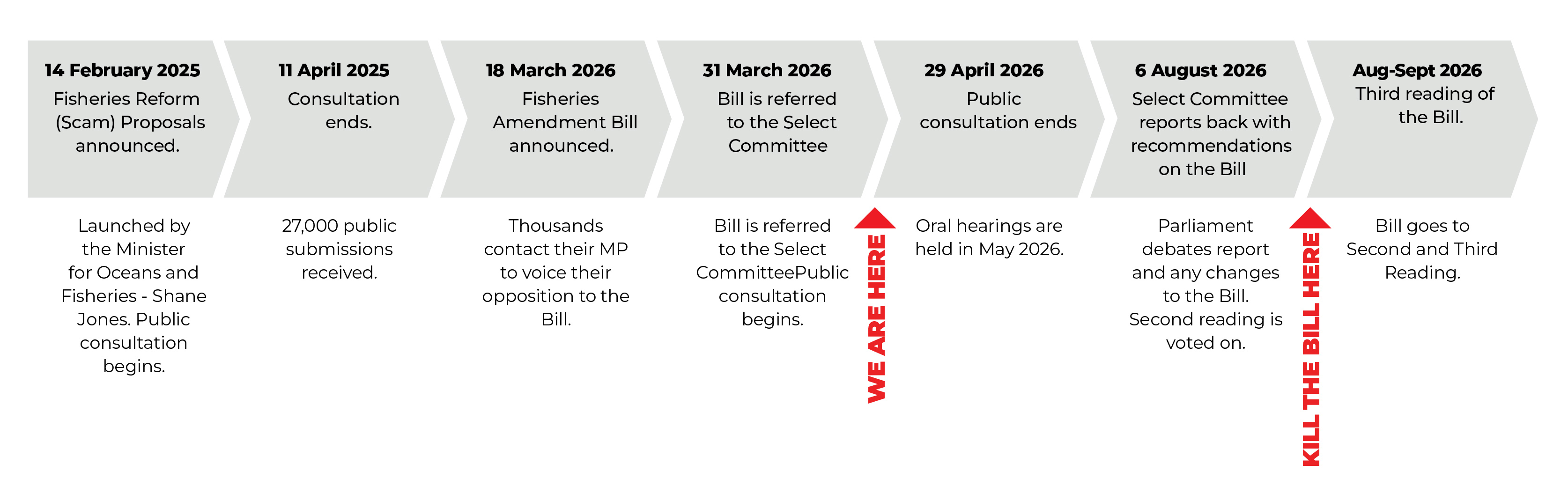
In May 2026, more than 33,000 people joined LegaSea and the New Zealand Sport Council in opposing the Bill. Public consultation has closed. The Bill is now with the Select Committee.
The Committee must report back to Parliament by August 6 with any recommendations or changes to the Bill.
Politicians want to pass this Bill before the election. We have the power to stop them, but only if we keep the pressure on.
You can help by writing to your MP to urge them to Kill the Bill by voting against at the next reading.
The process
The main proposals were released in February 2025 where over 27,000 people made submissions, predominantly rejecting them in their entirety. Our opposition has been ignored. The 2025 proposals form the basis of the Fisheries Amendment Bill 2026.
After the Select Committee has reported back to Parliament in August 2026, the Bill will be voted on after the 2nd Reading. This is where we need to Kill the Bill.
What’s in the Bill
The Fisheries Amendment Bill is fundamentally flawed. It includes a comprehensive range of changes to the Fisheries Act that favour large quota owning fishing companies. Our main concerns are:
- The Bill prioritises exports and private interests. Feeding Kiwis must come first.
- Lack of transparency. No public access to camera footage. Decision making goes behind closed doors while public input is limited.
- The Bill destroys environmental safeguards so the Minister can legalise dumping and the catch of undersized fish, while increasing commercial catch limits. We can expect more trawling along our coastline.
Below is a list of the relevant points of the Bill and our concerns.
| Clause | Proposal | Core issues |
| Onboard camera footage
New section 227 and section 252
|
|
|
| 20 working day limit for judicial review
New section 313A Relevant articles:
|
|
|
| Minimum legal sizes
Amend Regulation 31 Fisheries (Commercial Fishing) Regulations |
|
|
| Sustainability measures other than total allowable catch
Amended section 11 Relevant articles: |
|
|
| Standard factors when setting catch limits
Amended section 13 |
|
|
| Low information stocks
New section 13D |
|
|
| In-season catch limit increase
New section 13E |
|
|
| Consideration of environmental matters in setting a Total Allowable Catch
New section 13F |
|
|
| Multi-year catch decisions
New section 14F |
|
|
| Recognise commercial non-regulatory measures
New sections 14I, 14J, 14K |
|
|
| Management procedures
New sections 14L-14T |
|
|
| Management procedures – proportional allocation
New section 14L |
|
|
| Carry-forward Annual Catch Entitlement (ACE)
New section 67C and section 67D |
|
|
| Returns and discards of fish
Amendment to section 72(3A) |
|
|
| Increase in total allowable commercial catch to reflect discards
New subpart 4(23) |
|
|
| New deemed value fines
New section 75(5A) Relevant artlices: |
|
|
This Bill is reckless and short-sighted. It removes critical checks and balances that safeguard our marine environment. With your support, we can show the government that Kiwis won’t stand by and let this happen.
The changes are not a reform. They are a scam. They jeopardise the health of our marine environment. Our access to a healthy and abundant fishery is on the line. Don’t let it be cut.
We need thousands of people to speak up. It will take less than 5 minutes to make a submission using LegaSea’s online form. Tell the Minister you reject the privatisation of our fisheries.
Want to do more?
- Make a submission.
- Get your best mate to make a submission.
- Get your family to make a submission.
FAQs
Who benefits from removing environmental safeguards in the Fisheries Act?
Removing environmental considerations when setting catch limits benefits the short-term profits for quota shareholders, the people and entities who make money from leasing or owning quota. The costs, however, will be borne by the marine environment, small-scale commercial fishers, the public and future generations.Why should impacts on the wider marine environment be considered when setting catch limits?
Because fish live in a marine ecosystem. The Minister must consider the impacts of fishing on the marine environment to ensure that commercial fishing doesn’t undermine the health of fish populations or the ecosystems they depend on. A healthy marine environment supports abundant fisheries and our ability to catch fish for now and future generations.Why does the Minister want to remove environmental safeguards in the Fisheries Act?
Because it will make it easier to increase commercial catch limits without the Minister considering the long-term damage to marine habitats, impacts on other species outside of the Quota Management System, and the health of the wider marine environment.Isn’t the Fisheries Amendment Bill about speeding up decision making?
Speed is not the problem. Cutting public rights and limiting scrutiny is. Fisheries decisions affect shared, finite resources and require careful, evidence-based consideration. Faster is not better if it increases the risk of depletion.
What are LegaSea’s main concerns with the Fisheries Amendment Bill?
The Fisheries Amendment Bill is fundamentally flawed and does not deliver a better future for our fisheries. Our marine environment. Or us. Specifically the Bill will: Remove environmental safeguards, allowing the Minister to set catch limits without considering the wider consequences of fishing on the marine environment and other species. Shut the public out of […]How do I make a submission on the Fisheries Amendment Bill?
PUBLIC CONSULTATION HAS CLOSED. LegaSea has created an online template to help guide your submission. Once you’ve built your submission, copy and paste the content into the form on the Parliamentary webpage. The original deadline for submissions was 29 April 2026, that deadline has now been extended to 6 May 2026.Has the amendment to remove commercial minimum size limits been removed from the Fisheries Amendment Bill?
No. The amendment to remove commercial minimum size limits for nine finfish species including snapper, tarakihi, and trevally still remains in the Fisheries Amendment Bill. The Prime Minister publicly stated on March 25th 2026, that National would consider removing this amendment at the Select Committee stage.How can I help Kill the Fisheries Amendment Bill?
Strong public pressure is the only thing that will stop the Fisheries Amendment Bill. Email your local MP and urge them to reject the Bill. Click here to find your local MP’s details. Then go tell your friends and family to write to their MP. Tell them this will be one of the most important […]Supporting information:
Media Releases
- Fisheries reforms prioritise Industry over public interest – 14 February 2025
Articles
- Officials flag risks in Jones’ bid to cut penalties for deepwater fisheries – Newsroom, 23 Jan 2026
- Shane Jones plans bycatch rule shake-up to cut costs for deepwater fishers – Northern Advocate, 16 Jan 2026
- Fisheries Ministers’s constraint on court challenges ‘restrictive’ – officials – Newsroom, 27 Aug 2025
- Government agrees to pro-industry fisheries changes – NZ Herald, 6 Aug 2025
- Fishing industry nets changes to cameras, discards and catch restrictions – Newsroom, 6 Aug 2025
- Reforms to allow greater catch limits, on-board camera footage to stay hidden – Radio NZ, 6 Aug 2025
- Privatisation proposals shrouded in weasel speak – LegaSea, 11 March 2025
- Public loses out on fisheries deregulation – LegaSea, 25 Feb 2025
- Shane Jones Fisheries Reforms Prioritise Industry over Public Interest – LegaSea, 12 Feb 2025
Newsletters
- The reform scam returns – and it still stinks – 6 Aug 2025
- Shane Jones is an Island (and not a healthy one) – 20 March 2025
- Introducing the Fisheries Reform Scam – 12 March 2025
- Nothing to see here – Jones Threatens To Reduce Transparency – 5 March 2025
- Public fish, private profits – who does Shane Jones really serve? – 24 Feb 2025
More Information:
- A 2024 Ministry for Primary Industries report revealed a staggering 46% increase in fish being tossed overboard after cameras went live on a portion of the commercial vessels. The report shows that cameras are effective at incentivising improved reporting.
- Discards of kingfish have increased by 950% compared to what was previously reported.
- Discards of snapper have increased by over 1000% compared to what was previously reported.
- Reported dolphin captures were up by 680% times and albatross interactions by 350%.
- A 2019 Horizon Research study found 58% of New Zealanders thought bottom trawling that destroys fish habitats and targets small fish in the inshore fishery should be banned.
- The same Horizon Research study found 70% of New Zealanders believed that fisheries needed to be reformed to ensure there is an abundant fishery. Not to deregulate the controls on commercial fishing.
- Two Ministry for Primary Industries research projects, from 2016 and 2021, cover the operation of cameras to monitor catches aboard commercial fishing vessels. Reviewing 100% of all catch sorting and stowing for all vessels is not humanly possible. There are limitations. Even with AI there is no way to determine from the camera footage the exact size of fish or weight of a bin of fish.Even with cameras, management will need to rely on trust and the self-reported data provided by commercial fishers. Until technology and placement improves, cameras are no substitute for onboard human observers. Current rates of observer coverage of inshore commercial fishing activity is poor.
- Pria, M.J.; Pierre, J.P.; McElderry, H.; Beck, M. (2016). Using Electronic Monitoring to Document Snapper Discards and Validate Catch effort Data.
New Zealand Fisheries Assessment Report 2016/57. 38 p. - Middleton, D.A.J.; Guard, D. (2021). Summary and evaluation of the electronic monitoring programmes in the SNA 1 trawl and bottom longline fisheries.
New Zealand Fisheries Assessment Report 2021/37. 69 p.
- Pria, M.J.; Pierre, J.P.; McElderry, H.; Beck, M. (2016). Using Electronic Monitoring to Document Snapper Discards and Validate Catch effort Data.
- A 2016 study found the total economic contribution of marine recreational fishing by residents and visitors was $1.7 billion per annum, while taking less than 6% of the national catch. Recreational fishing contributes a conservative $188 million in tax revenues to help keep New Zealand functioning, while generating full-time employment for over 8,000 people.
- Holdsworth, J; Rea, T; Southwick, R. Recreational Fishing in New Zealand – A Billion Dollar Industry. Produced for the New Zealand Marine Research Foundation. March 2016.
Related articles
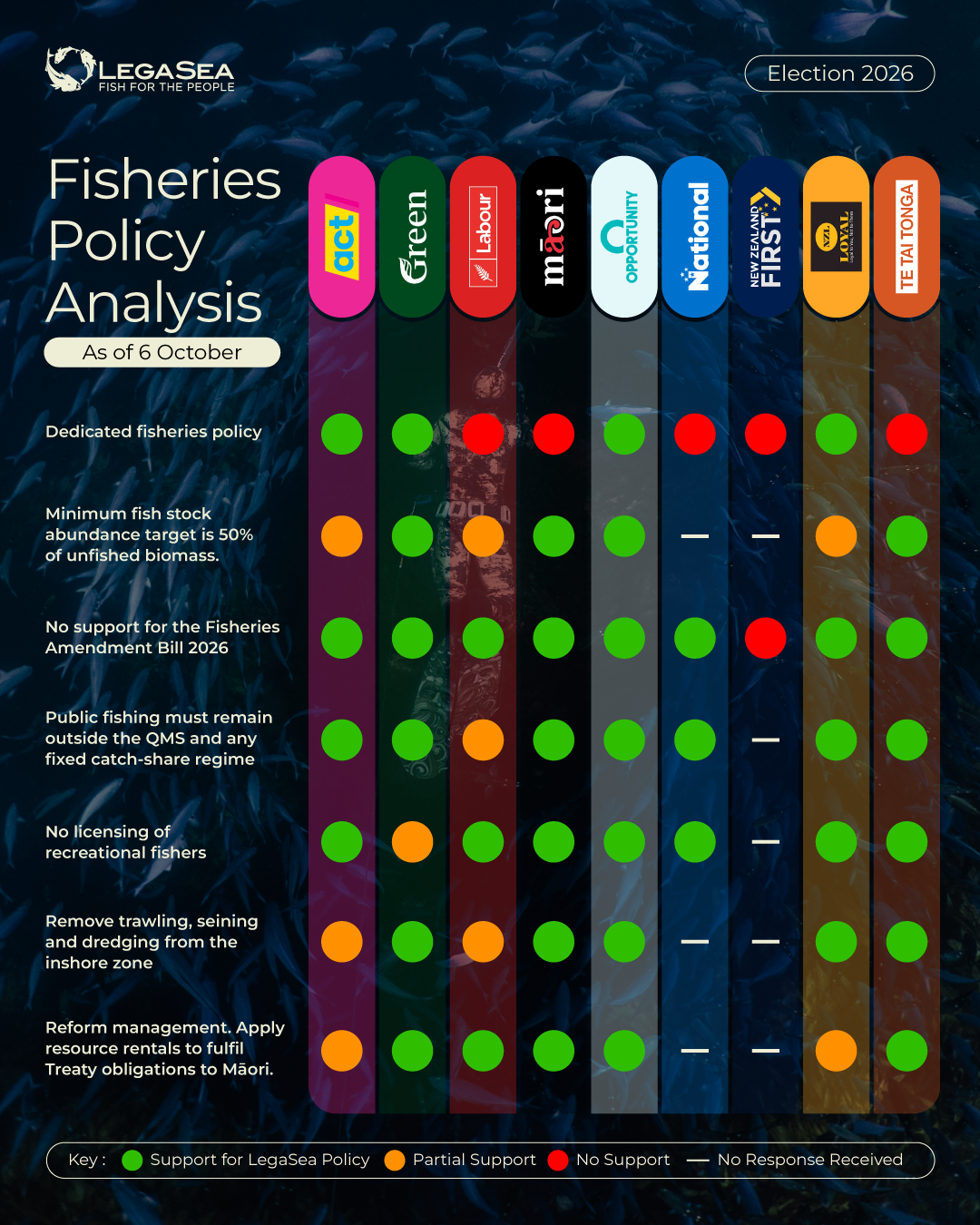
Fisheries is an election issue
Proportionality – the end to fishing as we know it
The Bill is on Ice – but we’re left with a failing system
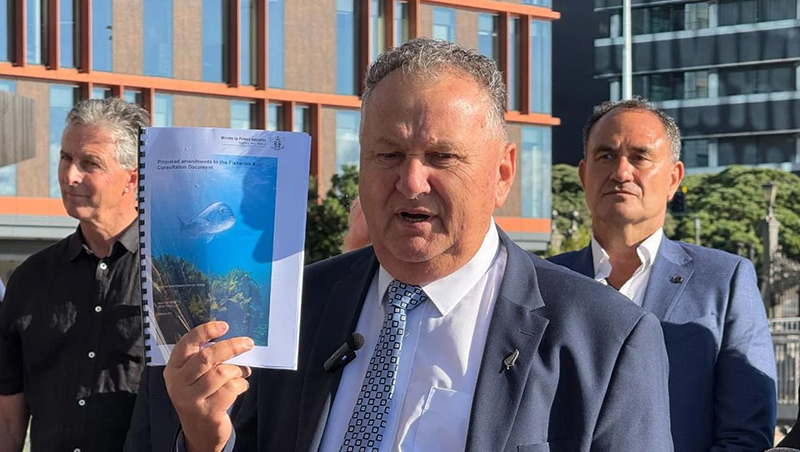
MEDIA RELEASE: Fisheries Amendment Bill put on ice
LegaSea Newsletter #187 – The Fisheries Amendment Bill is not dead…Yet
The Bill is not dead…Yet
MEDIA RELEASE: Kiwis reject fishing reforms, new survey finds
Just 16 days
Radical path to privatisation of fish